Cognify
FeaturesFAQs

Empowering Trainees

with Cognify AI

Access training materials instantly. Get intelligent answers from your trainers' knowledge base. Excel in your journey with Cognify.
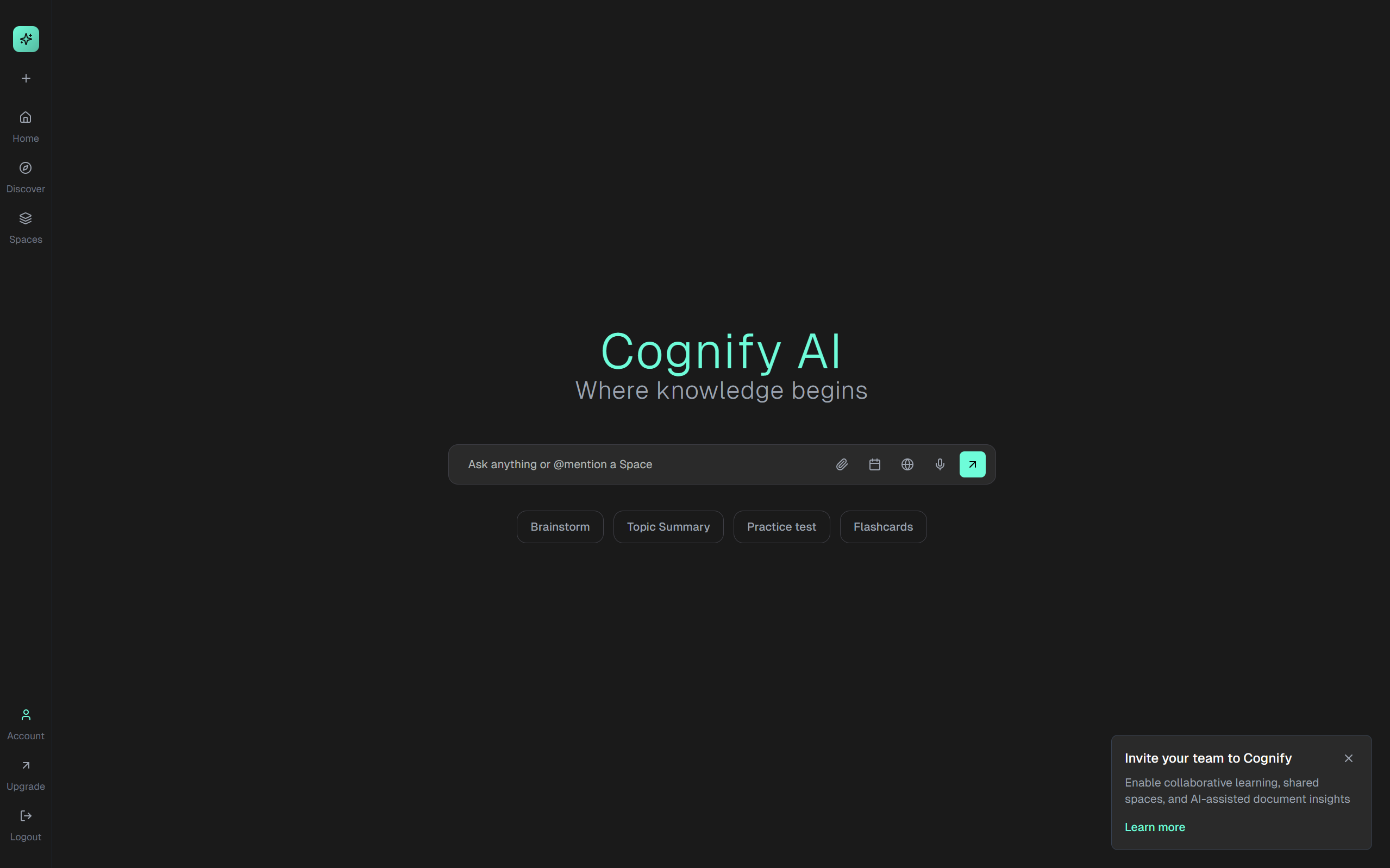
Dashboard preview

Essential Features for Training

Ask questions about training materials and get real-time answers with verifiable sources, powered by your trainers' knowledge base.

Shared Notes & Ideas
Build a common pool of knowledge with notes and articles from classmates.

Q
User Query
just now
"How do you implement efficient vector similarity search for large datasets?"
🔎 Searching in 45 articles...
🔎 Searching in 10 books...
🔎 Searching in 23 notes...
🔎 Searching in 12 pasted texts...

Answers with Sources
Every AI answer shows where it came from, so you can double-check easily.

"What are the best practices for RAG implementation?"

For effective RAG implementation, use [1] chunking strategies with 200-500 tokens per chunk.

Implement hybrid search combining semantic and keyword approaches [2] for better retrieval accuracy.

Sources:
1
"Advanced RAG Techniques" - OpenAI Research
2
"Hybrid Search in Production" - Pinecone Docs

Ask & Find Together
Save time by seeing past questions and the top AI-powered answer.

User asked: “What are the best optimization methods for deep neural networks?”
✅ Found similar community answer (32 upvotes)
The best optimization methods are Adam, SGD with momentum, and learning rate schedules. For deep nets, gradient clipping and weight decay also help reduce overfitting.

Checked by Peers
Keep answers accurate with peer reviews, ratings, and approvals.

Knowledge Validation
✓ Verified
"Vector databases like Pinecone offer sub-millisecond query times for similarity search at scale."
Submitted by Sarah K. • 3 hours ago
✓
Accuracy Check
8/10 experts agree
✓
Source Verification
3 sources confirmed
!
Recency Check
Needs update

Quick AI Summaries
Turn long textbooks or articles into short, simple summaries you can revise faster.

AI Summary Generation
Processing ...
Synthesizing from 12 sources:
Research Paper
Blog Post
Documentation
Tutorial
+8 more
Key Insights:
• Vector databases excel at similarity search with sub-millisecond latency
• Hybrid approaches combining dense and sparse vectors show 23% improvement
• Production deployments require careful index optimization strategies

Easy Uploads
Add your notes, PDFs, or links in one click to grow the shared library.

Content Ingestion Pipeline
🔄 Active
📄
PDF Documents
247 files processed
✓ Complete
🌐
Web Articles
1,432 articles indexed
✓ Complete
📊
API Endpoints
Real-time sync active
🔄 Syncing
2.1M
Documents
847GB
Processed
99.7%
Accuracy
1 / 6

Shared Notes & Ideas
Build a common pool of knowledge with notes and articles from classmates.

Q
User Query
just now
"How do you implement efficient vector similarity search for large datasets?"
🔎 Searching in 45 articles...
🔎 Searching in 10 books...
🔎 Searching in 23 notes...
🔎 Searching in 12 pasted texts...

Answers with Sources
Every AI answer shows where it came from, so you can double-check easily.

"What are the best practices for RAG implementation?"

For effective RAG implementation, use [1] chunking strategies with 200-500 tokens per chunk.

Implement hybrid search combining semantic and keyword approaches [2] for better retrieval accuracy.

Sources:
1
"Advanced RAG Techniques" - OpenAI Research
2
"Hybrid Search in Production" - Pinecone Docs

Ask & Find Together
Save time by seeing past questions and the top AI-powered answer.

User asked: “What are the best optimization methods for deep neural networks?”
✅ Found similar community answer (32 upvotes)
The best optimization methods are Adam, SGD with momentum, and learning rate schedules. For deep nets, gradient clipping and weight decay also help reduce overfitting.

Checked by Peers
Keep answers accurate with peer reviews, ratings, and approvals.

Knowledge Validation
✓ Verified
"Vector databases like Pinecone offer sub-millisecond query times for similarity search at scale."
Submitted by Sarah K. • 3 hours ago
✓
Accuracy Check
8/10 experts agree
✓
Source Verification
3 sources confirmed
!
Recency Check
Needs update

Quick AI Summaries
Turn long textbooks or articles into short, simple summaries you can revise faster.

AI Summary Generation
Processing ...
Synthesizing from 12 sources:
Research Paper
Blog Post
Documentation
Tutorial
+8 more
Key Insights:
• Vector databases excel at similarity search with sub-millisecond latency
• Hybrid approaches combining dense and sparse vectors show 23% improvement
• Production deployments require careful index optimization strategies

Easy Uploads
Add your notes, PDFs, or links in one click to grow the shared library.

Content Ingestion Pipeline
🔄 Active
📄
PDF Documents
247 files processed
✓ Complete
🌐
Web Articles
1,432 articles indexed
✓ Complete
📊
API Endpoints
Real-time sync active
🔄 Syncing
2.1M
Documents
847GB
Processed
99.7%
Accuracy

"Cognify transforms how we deliver training. Trainees get instant, accurate answers, and we ensure consistent knowledge delivery across all cohorts."

Cognify Team

Cognify AI Systems

Frequently Asked Questions

Everything you need to know about Cognify and how it supports your learning journey

What is Cognify?
Cognify is an AI-powered learning platform designed specifically for trainees. It helps you access training materials uploaded by your trainers (POCs, Technical Trainers, BH Trainers, Mentors, and CRs) and get instant, intelligent answers to your training-related questions.
Who can upload training materials?
Only authorized trainers and coordinators can upload content: POCs (Point of Contact), Technical Trainers, Behavioral Trainers, Mentors, and Campus Recruit Coordinators. This ensures all training materials are verified and high-quality.
How does the AI assistant work?
Our system processes all training materials uploaded by your trainers into a searchable knowledge base. When you ask a question, the AI retrieves the most relevant information and provides precise answers backed by the original training content.
What kind of training materials are available?
Your trainers upload technical documentation, behavioral training guides, coding exercises, project requirements, company policies, and other training content. All materials are curated specifically for your cohort's learning needs.
Is this platform free for trainees?
Yes! The Cognify is provided to support your training journey. All trainees have full access to query the knowledge base and learn from the uploaded materials.
Can I access materials from other batches?
Each cohort has its own dedicated training space. You can only access materials uploaded specifically for your batch, ensuring relevant and focused content for your training phase.

Ready to Excel in Training?

Join your cohort and access instant answers from your trainers' curated knowledge base. Transform your training experience with AI-powered learning.

Cognify

AI-powered learning companion for trainees

Product

Features

Company

About usOur teamContact

Resources

Terms of useCommunitySupport